



















Sillage and Projection: What They Mean and How to Make a Perfume Last
Sillage is the scented trail a perfume leaves behind as you move through a room, while projection is how far the fragrance radiates from your skin at any given moment. In short, projection is the "bubble" around you right now, and sillage is the ribbon of scent people notice after you have passed. Both decide whether your fragrance quietly hugs your skin or announces you before you arrive.
TL;DR:
- Projection = how far a scent pushes out from your skin in the moment.
- Sillage = the lingering trail left in your wake.
- Higher concentration and heavier base notes (amber, oud, musk, woods, resins) generally project and last longer.
- Application, skin type, and storage all change how a perfume behaves on you.
Sillage vs projection: what is the difference?
People often use these two words interchangeably, but perfumers treat them as separate ideas. Getting the distinction right helps you shop smarter and describe what you actually want.
Projection describes the intensity and reach of a fragrance around you at a single point in time. A scent with strong projection fills the air near you and can be sensed by someone sitting across a table without them leaning in. A scent that "sits close to the skin" has low projection: you smell it, but others only catch it in a hug.
Sillage (pronounced roughly "see-yazh," from the French word for a boat's wake) is the trail. It is what lingers in a lift after you step out, or the drift of scent someone notices as you walk past. A fragrance can project strongly for an hour yet leave little trail, or it can sit close and still leave a soft, memorable ribbon behind. The two qualities are related but not identical.
What makes a fragrance project and linger?
Longevity and projection are not luck. A handful of factors decide whether a scent fades by lunch or carries into the evening.
Concentration
The share of aromatic oils in the liquid is the biggest lever. Eau de parfum carries more oil than eau de toilette, so it usually projects harder and clings longer. Extrait or parfum concentrations push this further still. More oil means more scent molecules on your skin, which means a bigger bubble and a longer life.
The weight of the base notes
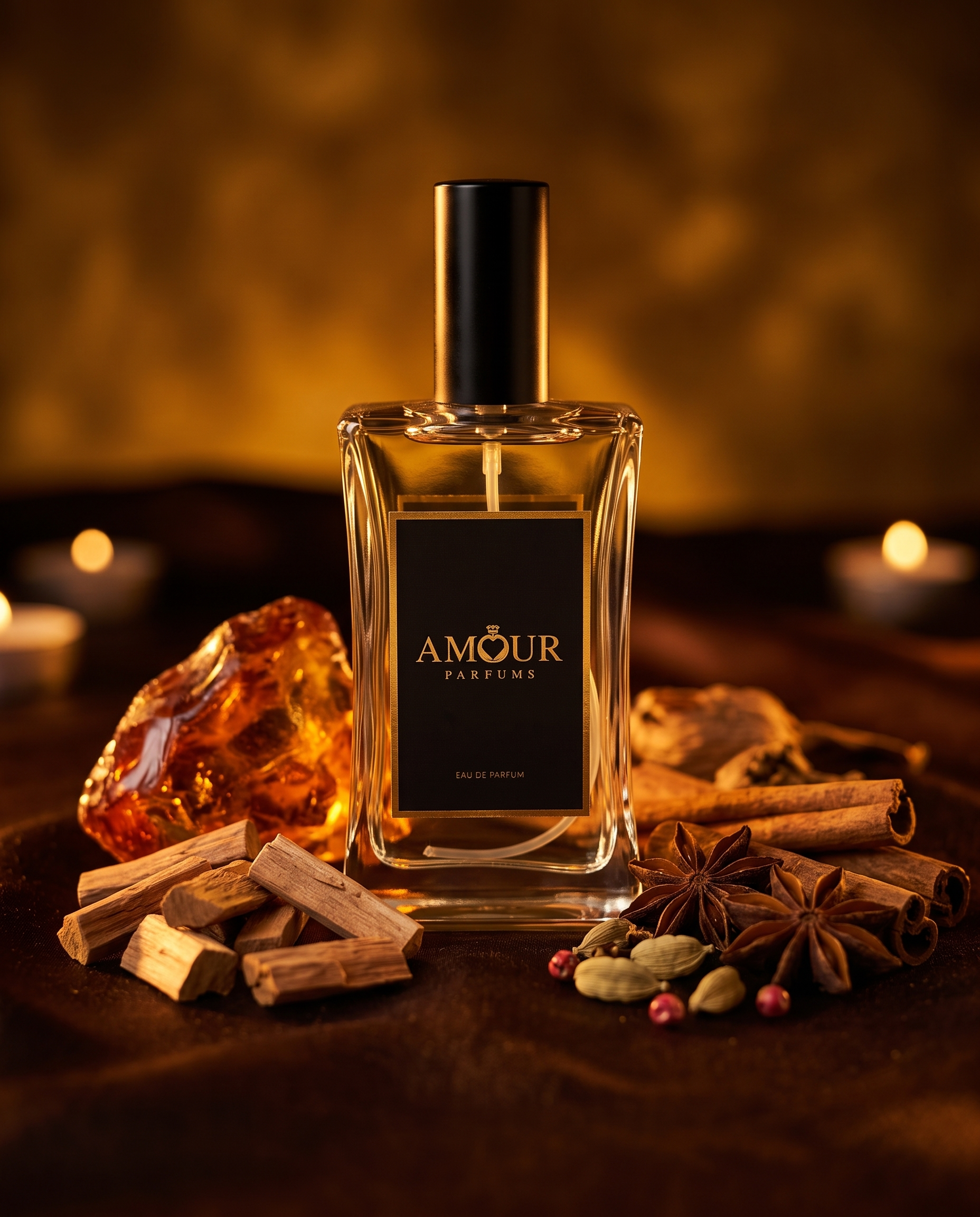
Notes are grouped into top, heart, and base by how quickly they evaporate. Top notes (citrus, light fruit, fresh herbs) flash off within minutes. Base notes are the heavyweights, and they do the long-haul work. Ingredients like amber, oud, musk, sandalwood and other woods, benzoin, tonka and resins are large, slow-evaporating molecules. They anchor a fragrance to the skin for hours and are the main reason some scents leave a trail long after application. If you want power and staying power, look for a scent built on a rich, resinous, woody or musky base.
Your skin
Perfume behaves differently on every person. Oily and well-moisturised skin holds fragrance longer because the oils give scent molecules something to bind to. Dry skin lets a fragrance evaporate faster, so it can seem to vanish more quickly. Body heat, diet, and even hormonal changes shift how a scent unfolds, which is why the same bottle can smell bolder on a friend than on you.
How and where you apply it
The same perfume can feel weak or commanding depending purely on technique. Spraying onto warm pulse points, layering with matching body products, and not rubbing the scent away all make a real difference, which brings us to the practical part.
How to get more sillage: 8 practical tips
- Moisturise first. Apply an unscented lotion or a light body oil before you spray. Hydrated skin holds fragrance far longer than dry skin, and the oil slows evaporation.
- Target your pulse points. Wrists, the base of the throat, behind the ears, the inner elbows and behind the knees run warm. That warmth gently diffuses the scent all day, feeding both projection and sillage.
- Do not rub your wrists together. Rubbing generates friction and heat that fractures the top notes and can flatten the development. Spray, then let it dry naturally.
- Spray onto skin, not into a cloud you walk through. Hold the bottle a few centimetres away and apply directly. Most of a mist sprayed into the air never lands on you.
- Layer it. Using a matching or complementary shower gel, deodorant or body cream builds a scent foundation. Each layer reinforces the others and extends how long the fragrance reads on you.
- Apply to hair and clothing, carefully. Hair holds scent beautifully and swings a trail as you move; a light mist on a brush works well. On fabric, test first, because oils in some perfumes can stain delicate or pale materials. Keep sprays light and away from silk and leather.
- Store your bottle properly. Heat, light and humidity break fragrance down. Keep bottles in a cool, dark, dry place, in the box if you can, and off the bathroom windowsill. A well-stored perfume projects the way it was designed to.
- Reapply strategically. Even long-lasting scents settle over the day. A single touch-up to a pulse point in the late afternoon revives the projection without overloading the fragrance.
Three AMOUR fragrances built to project
Some scents are engineered around exactly the heavy, slow base notes that create reach and a lasting trail. Here are three from the AMOUR catalogue that reward anyone chasing sillage, described purely by their notes and accords.
A bold, spicy statement for men
AMOUR No. 221 is a men's fragrance that opens with warm spices, rum and tobacco, then moves through leather, iris and tuberose into a base of tonka bean, guaiac wood and benzoin. The accord is warm-spicy, woody and leathery with an amber-tobacco sweetness. That resin-and-wood foundation is what gives it real projection and a trail that lingers, making it a natural pick for cool evenings and confident occasions.
A creamy, powdery cling for women
AMOUR No. 173 is a women's fragrance that begins with coconut, plum and apricot, blooms into tuberose, rose, jasmine and lily-of-the-valley, and settles on vanilla, almond, musk, sandalwood and amber. It reads woody, sweet, powdery and musky with a soft coconut warmth. The musk-and-vanilla base is the kind that clings quietly to skin and fabric for hours, leaving a gentle, comforting sillage rather than a loud one, ideal for anyone who wants presence without shouting.
An oud powerhouse for anyone
AMOUR No. 289 is a unisex fragrance that sparks with cardamom and Sichuan pepper before descending into a deep base of agarwood (oud), Brazilian rosewood, sandalwood, vanilla, vetiver, tonka bean and amber. Woody, balsamic, warm-spicy and unmistakably oud-driven, this is the biggest projector of the three. Oud and resins are among the heaviest fragrance materials there are, so a small amount travels far and lasts long. Apply sparingly and let it do the work.
Frequently asked questions
What is the difference between sillage and projection?
Projection is how far a fragrance radiates from your skin in the present moment, the size of the scent bubble around you. Sillage is the trail that lingers behind you as you move. Strong projection fills the room you are in; strong sillage is what people notice after you have left it.
Which notes last longest?
Base notes last longest because they are made of large, slow-evaporating molecules. Amber, oud, musk, sandalwood and other woods, benzoin, tonka bean and resins are the classic long-lasting anchors. Top notes such as citrus and light fruit fade within minutes, while heart notes bridge the two stages.
Does eau de parfum project more than eau de toilette?
Generally, yes. Eau de parfum contains a higher concentration of aromatic oils than eau de toilette, so it tends to project more strongly and last longer on the skin. That said, the specific ingredients matter too: a well-built eau de toilette rich in woods and musk can outlast a lighter, citrus-heavy eau de parfum.
How can I make my perfume last all day?
Moisturise before applying, spray onto warm pulse points, avoid rubbing, and layer with matching body products where you can. Choosing a fragrance built on heavier base notes helps enormously, and a single light touch-up in the afternoon keeps the projection alive into the evening.
Do stronger perfumes give a headache?
They can, if over-applied, because a dense cloud of scent can feel overwhelming in enclosed spaces. The fix is usually restraint rather than a weaker perfume: a big-projecting scent needs only one or two sprays. Apply less, keep it to pulse points, and let the fragrance breathe rather than saturating the air around you.
Why does my perfume disappear on me but not on others?
Skin chemistry is the main reason. Dry skin lets fragrance evaporate faster, so a scent can seem to fade quickly even when others still smell it clearly. You also grow used to a scent you wear constantly (a phenomenon called olfactory fatigue), so it feels gone to you long before it has actually left your skin.
Find your signature trail
Sillage and projection are the difference between a perfume that whispers and one that leaves an impression. Once you understand how concentration, base notes, skin and application work together, you can choose and wear fragrances that behave exactly the way you want. Ready to find a scent that lasts and lingers? Explore the full AMOUR Parfums collection and discover the trail that feels like you.